When did reflection start feeling like a holiday?
A question from the field that should trouble every organisation in this sector.
Welcome
This edition comes from Helsinki. I have been in eight locations in six weeks, and this newsletter is my attempt to follow just one thread of many — a single idea that has kept returning, in different rooms, in different accents, across different systems.
The gap between frameworks and people.
An Update
Since I last wrote to you from Toronto, the fieldwork has moved into London, Birmingham, Edinburgh, Glasgow, and parts of rural Scotland. I have now spoken formally with more than 60 practitioners, researchers, executives, professional body leaders, and educators. Some conversations lasted three hours, some produced ideas I am still turning over.
I'll be honest about what this volume of data feels like from the inside. It can feel a bit overwhelming, like accumulation, and also like a series of small disturbances — moments when something I thought I understood shifts slightly, or when an idea I had fully signed up to gets challenged, leaving me not yet sure what is comfortable. Mostly it is exciting. Just when I think I have found a compelling answer, something more interesting appears around the corner.
What I am noticing
Four locations shaped this edition - London, Birmingham, Edinburgh and Glasgow. Each offered something distinct, and together they produced a pattern I had not anticipated.
In London, I spent time with Frontline, the organisation that built and ran England's national social work leadership program for practice supervisors, middle managers, and aspiring leaders, reaching more than 2,000 people before it was defunded by the Department for Education in 2024, not for reasons of quality, but of budget. I also spent time with the British Association of Social Workers, where a long conversation about what the Professional Capabilities Framework actually delivers for aspiring leaders. It is a map.
In Birmingham, conversations with the University of Birmingham and Birmingham City Council surfaced the most quantitatively grounded retention finding of the entire field period. In a local authority employee survey of 30,000 people, approximately 54 per cent of social workers cited their line manager or supervisor as the primary reason for staying. Not the program, the framework, the policy.
Scotland has more formal policy and structural architecture for social work than any other country I have visited. A national social work agency, a career framework, a new national practice standard — all standing up in the past two years. By any measure, this is impressive. And yet, in many conversations I heard something I was not expecting. Frontline workers did not know the national agency existed, and the new framework was largely unknown to the people it was designed to serve.
A researcher I spoke with in Edinburgh offered a formulation that is useful - frameworks are maps, not the territory. The map can be exquisitely detailed, the roads still have to be built.
This matters beyond Scotland. I saw a version of it in Toronto, where an implementation scientist spent two hours walking me through the question of why good programs disappear, not because they fail, but because the conditions that hold them are fragile. I saw it in England, where that national leadership program was defunded mid-delivery. I saw it in the US, where the programs that survived across budget cycles had one thing in common: they had been written into law.
The pattern emerging across the full field period is not that the ideas or programs are missing. It is that the infrastructure to carry them to the people who need them is missing, or fragile, or dependent on the goodwill of whoever holds the budget this year. Or — and this detail from Edinburgh has stayed with me — dependent on a single social worker, without asking for permission, quietly facilitating a peer cohort that one grateful colleague described as helping him return to the social work mother ship.
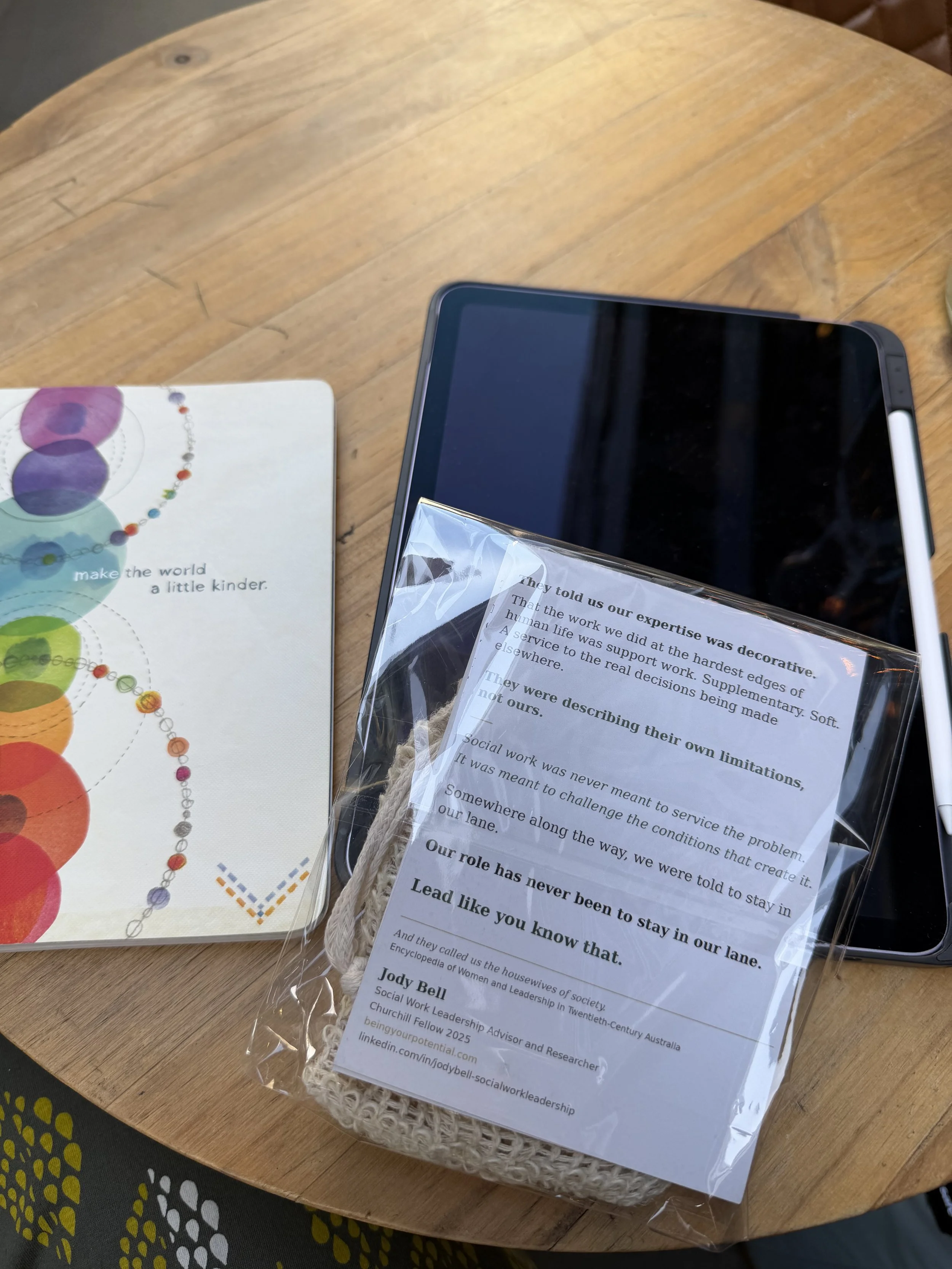
Everything I need for a day in the field. London, May 2026.
Something closer in
Alongside the systems question, across London, Birmingham, and Scotland, a thread appeared in different forms in each location. In England, it was named as a question of what leadership development actually protects — not skills, but identity. In Birmingham, it emerged in accounts of social workers who no longer knew what social work was for, post-COVID. In Scotland, it was put most precisely by a senior figure I spoke with who has spent many years working with people at the most senior levels of the profession.
They described how social workers build their leadership identity the same way they build everything else: from what they have been shown. Every supervisor they ever had, every manager they ever watched, every moment of leadership modelled in front of them, whether that modelling was intentional or not. The good pieces and the not-so-good pieces, assembled over years into something that functions as a professional self.
The problem, they said, is what happens when that becomes the raw material for how someone leads their own team for the first time.
If the only supervision you ever received was accountability supervision — have you done this, is the paperwork filed, is the case updated — then that is the model you carry into the room when you sit across from your own people. Not because you lack values or because you do not know better, because that is the only version of management (not actually leadership) that has been put close enough for you to absorb.
They traced it all the way through. In some parts of Scotland, the most experienced social worker in a team has been qualified for three years. If that person is promoted, the only supervision they have ever received is what they will replicate when they are the one doing the supervising. The conditions that produce poor developmental cultures are the predictable output of a system with no investment at the point where it matters most.
This is not a Scottish problem. I have heard versions of this in every location.
What stayed with me is not the diagnosis. It is the question this same person described returning to, across many decades of their work, as a way of reanchoring.
Whose side are you on?
I think it's a great orienting question. One you could take into the hard moments — the budget decisions, the conversations with a manager asking you to do something that does not sit right, the Friday afternoons when the case is complex and you are tired — not to resolve the tension, but to remember why you are there and what you are there to protect.
They said if you have not asked yourself that question regularly across your career, you are not equipped to lead from it.
And one more compelling thing, they described leaders in programs reporting that they very rarely get time to reflect, and that when they do, it feels like a holiday!
That phrase should trouble every organisation in this sector.
Reflective practice is not a wellbeing extra. It is not something that happens when the caseload allows. It is the mechanism through which sound, ethical, legally defensible judgement is maintained over time. When someone is in front of you with a situation that is complex and urgent, and you are operating purely from instinct and habit with no space to step back, the risk is not only to your own wellbeing, it is to the quality of the decision, and to the person who needs a good one made on their behalf.
One social worker I interviewed offered this - even if you just go to the toilet, take twenty seconds. Do not bounce into it. Slow down before the decision, not after.
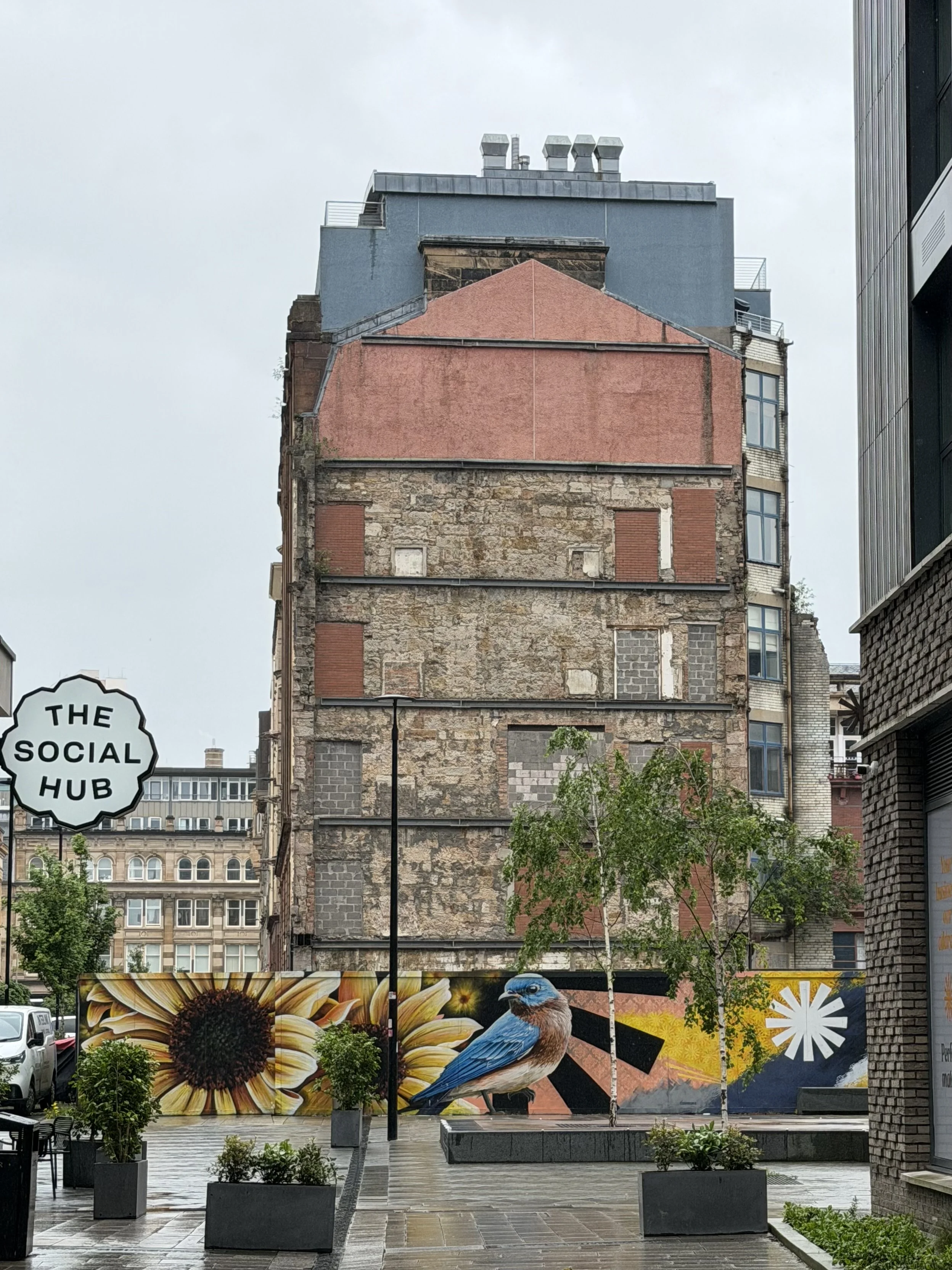
The Social Hub, Glasgow, June 2026. Some locations set the tone before the conversation even begins.
A question for you
I am curious about your own professional architecture — not the frameworks above you, but the ones you have built, over time, to stay anchored.
When the gap opens up between what you know is right and what the system is asking of you, what do you return to?
And is that something you have ever named out loud, to someone who understands the work?
There is something important in the naming. Across every location I have visited, the leaders who seem most able to hold their values under pressure are not the ones with the best frameworks above them and they are the ones who have, somewhere in their working life, found spaces with other people asking similar questions together.
With kindness, Jody
Your Trusted Guide Outside the System | Founder, Being Your Potential | Churchill Fellow 2025