Social Work Leadership: Why the Cohort Teaches What Curriculum Cannot
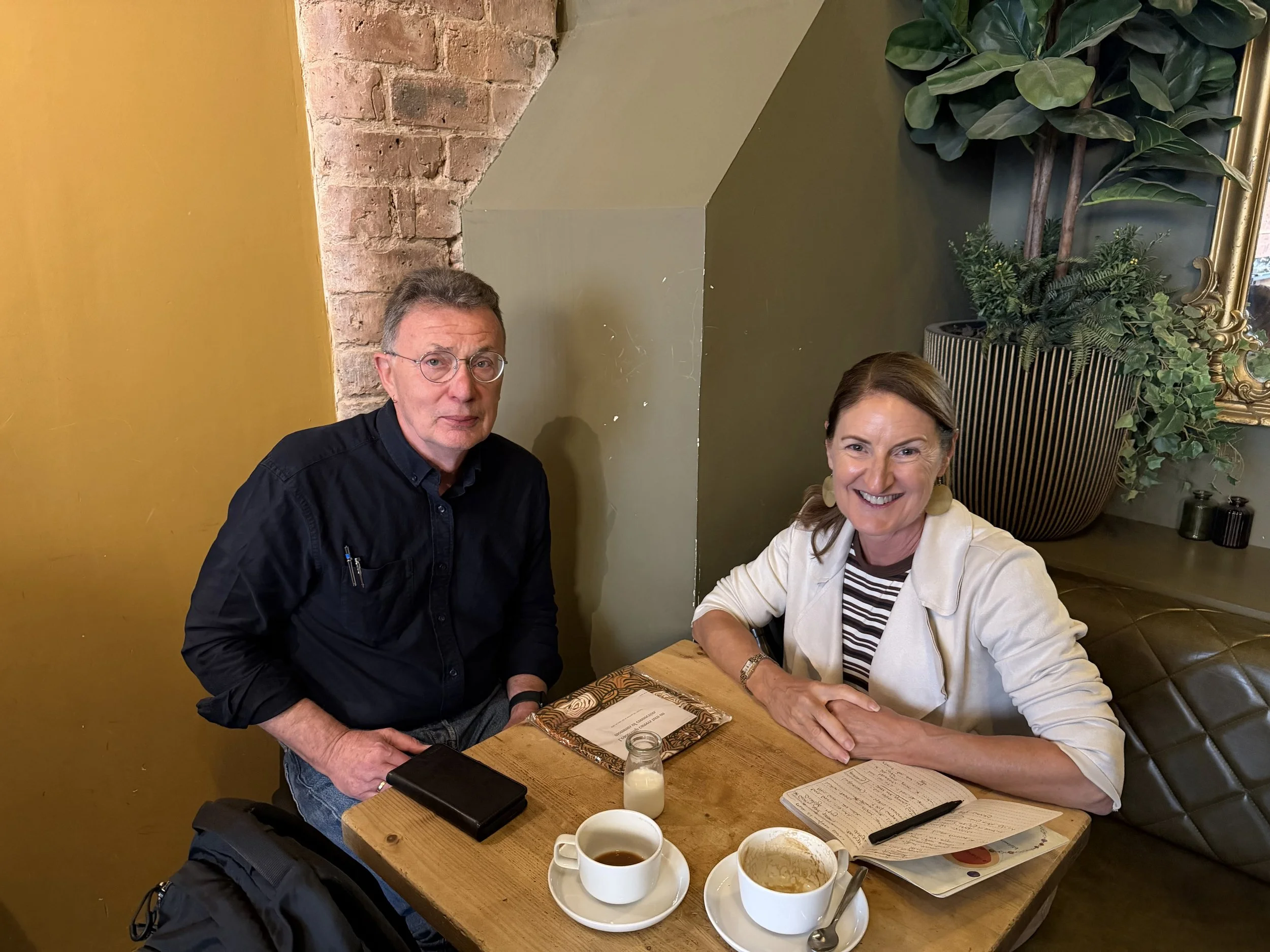
Two insightful hours with Dr Martin Kettle, Kaffateria, Glasgow, 3 June 2026
Social work leadership has a transmission problem and Dr Martin Kettle, Programme Lead for the MSc in Social Work and the Postgraduate Award Chief Social Work Officer, has spent over a decade doing something about it.
I walked into a cafe in Glasgow in early June 2026 not entirely sure what I was about to hear. Martin and I had connected virtually prior to me beginning my field work. We had a little joke about the cricket!
I knew Martin had developed and been running the Postgraduate Diploma for Chief Social Work Officers for ten years. I knew it was the only formal leadership qualification at that level in Scotland. He shared with me that 14 of the currently serving Chief Social Work Officers in Scotland were graduates of his program, that the head of the new National Social Work Agency had come through a cohort, but what I did not expect was that the most important thing he would say had almost nothing to do with Chief Social Work Officers.
The hardest move
I asked a version of the same question in all countries: what is the hardest transition in a social work career?
Martin answered without hesitating. Not the move to a senior leadership role or the shift from one organisation to another, for him, it was the first social worker to manager.
He called it the Frankenstein model. He described how social workers build their professional identity across their early career by observing the people around them, taking the pieces they respect, discarding the pieces they do not, and constructing something from the combination. This is not a deficit, it's how professional identity actually forms. It is also, he said, much the same thing that happens when people become managers for the first time.
If the only supervision you ever received was accountability supervision, that is: have you done this, has the case been updated, is the paperwork in? Then that is the raw material you bring to the table when you are sitting across from your own team for the first time. Not because you lack values or because you do not know better, because in the "messy" middle”, that is often the only model you know.
Martin described one of his Chief Social Work Officer graduates whose work-based project was on this same issue. He had moved into a new senior role, looked carefully at what was happening in the supervision sessions his staff were receiving, and found supervision as accounting: a checklist, a record of tasks completed or not and no space to think and no developmental function. No moments where someone asked: what are you learning, who are you becoming, what does this case ask of you as a practitioner?
Martin traced it back. In some parts of Scotland, the most experienced social worker in a team has been qualified for three years. If that person gets promoted, the only supervision they have ever received is what they will replicate. The conditions that produce managerial supervision are the predictable output of a leadership pipeline with no developmental infrastructure at the point where it matters most.
This is not a Scottish problem. I heard versions of this finding in every country I have visited.
Reflection is not a luxury
Martin described leaders in the program reporting that they very rarely get time to reflect, and that when they do, it feels like a holiday!
That phrase should trouble every organisation in this sector. Reflective practice is not a wellbeing extra. It is not something that happens when the caseload allows. It is the mechanism through which social workers make sound, moral, ethical, and legally defensible decisions. When someone is in front of you with a complex situation, and you are operating largely from instinct and habit without any space to step back and think, the risks are not only to wellbeing, they are to practice quality, to professional judgement, and to the people in those rooms who need good decisions to be made on their behalf.
Martin was also explicit that this is not about sending people on courses. It is about building the habit of reflection into the ordinary rhythm of leadership. Slowing down before the decision, not after. His shorthand: even if you just go to the toilet. Take twenty seconds. Do not bounce into it.
Compassionate leadership, and why it is not soft
I asked Martin which leadership frameworks he draws on in the program. He was candid and he had come to compassionate leadership through a somewhat indirect route, doing a mindfulness studies qualification in his 50s, which he described with considerable dryness as happening because he decided he did not have enough degrees!
But what followed was not dryness at all. He described spending several years looking seriously at the evidence on compassionate leadership, including the now substantial body of work on self-compassion, and arriving at a conviction that it belongs at the centre of how we prepare social work leaders.
I want to be explicit about what this means, because it is often misread and it also relates to empathy I think. Compassionate leadership does not mean avoiding hard decisions, softening feedback or withholding difficult truths. Some of the hardest conversations I have witnessed in organisational life have been led by people with a genuinely compassionate orientation. What compassion changes is not the decision, it is the quality of attention you bring to the person affected by it. You can deliver a decision that is difficult, even devastating, in a way that preserves someone's dignity and does not destroy the relationship. That requires something and that something is that you have done the work on yourself first. Another parallel process: social work acknowledges the use of self in practice; we ask students to incorporate it into their practice frameworks during placement. I would suggest this also extends to your leadership approach.
Back to self-compassion, if you cannot extend that quality of attention to yourself when you are uncertain, out of your depth, tried something and it did not go the way you had hoped, you will not be able to extend it to others consistently. Martin was explicit about this, we are asking leaders to be vulnerable. We are asking them to open themselves up in a program that examines how they make decisions, what they believe, and whether their espoused values match their values in action. You cannot ask that of someone who has not practised it on themselves.
Brené Brown comes up in the first module. Adam Grant's thinking on intellectual humility comes up in the second. Not because they are fashionable, but because the capacity to change your mind, to think like a scientist rather than a prosecutor or a preacher, is directly relevant to the kind of judgement social work leadership requires.
What are we protecting?
At one point I raised a question a colleague had posed to me: why do we say social workers need their own leadership development, rather than sending them to generic programs? What are we protecting?
Martin thought for a moment, then said: the capacity to see the whole person. Not the broken leg in bed 22, the case reference. The person, in their context, in their circumstances, with the full complexity of what has brought them to this moment. He described social workers as having a distinctive epistemic orientation, one that spans boundaries, that operates across health, justice, housing, and community in ways that generic leadership training does not address. He said if you come to social work, you are coming to a profession where the fundamental question is whose side are you on. And if you have not asked yourself that question regularly across your career, you are not equipped to lead from it.
The becoming question
Martin described the moment in the program, in the final structured professional discussion, when participants reflect on how they came into social work and whether that person is still present in the leader they have become.
He talked about the Frankenstein model again here, but in a different register. Because by the time you reach the final module, you are not just thinking about what pieces you have picked up from supervisors and managers, you are thinking about the stories you have told yourself across your career. The story that said you were not ready or this role was too big for you. The story that said the discomfort you felt was a sign you should leave, rather than a sign you needed support.
He described the importance of giving people good questions rather than giving them answers, encouraging inquiry. Because a leader who knows how to ask better questions of their team is doing something that no supervision policy and no training program can replicate from the outside: they are building a culture of thinking.
He also described regularly reminding participants why they came into the work in the first place. What drew them to a profession where the person at the door is rarely having a good time. That reminder, he said, does something. It does not sentimentalise the work, it reconnects people to the reason the work is worth doing well.
The messy middle
There is no accredited leadership education in Scotland between newly qualified social worker and Chief Social Work Officer. Martin said attempts have been made to build something for the middle of the pipeline, but none have been sustained. The National Social Work Agency has a Culture and Leadership work stream that sounds promising.
He said if he had a magic wand, there would be something for people before they step into a formal leadership program and that begins the identity work early, creates the conditions for people to encounter, as he put it, a language for what is already happening to them.
The cohort is non-negotiable in his program. Over ten years, the curriculum design has consolidated around one learning: the relationships between the 18 people in the room is the developmental mechanism. The framework gives people the language. The cohort gives them somewhere to take it. The peer relationships, formed across two years and two campus residentials and everything in between, are still being used long after people have left. It is not only his own observation. An independent evaluation of the award, commissioned by the Scottish Government, reached the same finding.
Every field site on this fellowship has confirmed this. The peer group. The space where you can say what you cannot say in the building. That is where the becoming can happen.
I am a Churchill Fellow 2025, this was a conversation as part of my in field inquiry across nine countries looking at what contexts and everyday practices help aspiring and early-career social work leaders stay connected to their values as they move into formal leadership roles. My thanks to Dr Martin Kettle for his generosity, his candour, and the kind of career-long thinking that deserves to be heard well beyond Scotland.
If this resonated with your experience of leadership in social work or the care sector, I would welcome hearing what it brought up for you.
With kindness
Jody